SaaS & Startups
How to Validate Your SaaS Idea
By Yahya Saeed · 4 min read · 62 views
How to Validate Your SaaS Idea
Every successful SaaS starts with an idea.
But here's the truth:
Most ideas fail not because they're bad, but because nobody validates them before building.
Many developers spend months creating products they believe people need.
Then they launch...
Only to discover that no one signs up.
No one pays.
No one cares.
Validation helps you avoid that mistake.
Instead of building based on assumptions, you build based on evidence.
In this guide, you'll learn practical ways to validate your SaaS idea before investing months of your time.
What Does Validation Mean?
Validation simply means proving that your idea solves a real problem for real people.
It answers questions like:
Does this problem actually exist?
Who experiences it?
How painful is it?
Are people already paying to solve it?
Would they pay for a better solution?
If you can't answer these questions confidently, you probably need more validation.
Start With the Problem
Most founders begin with an idea.
Successful founders begin with a problem.
Ask yourself:
What frustrates people every day?
Which tasks are repetitive?
What consumes too much time?
What processes still rely on spreadsheets or notebooks?
What software do people constantly complain about?
Good businesses solve painful problems.
Solve Problems You Understand
The easiest products to validate are the ones connected to industries you already know.
Examples include:
Medical clinics
Restaurants
Schools
Freelancers
Retail stores
Construction companies
Small businesses
When you understand the industry, you understand the customer's pain.
Talk to Real People
Validation starts with conversations.
Find potential users and ask questions like:
What's your biggest challenge?
How do you solve it today?
What do you dislike about your current solution?
How much time does it waste?
Would you pay for something better?
Don't try to sell.
Try to learn.
Avoid Leading Questions
Don't ask:
"Would you use my amazing SaaS?"
Most people will politely say yes.
Instead ask:
How do you currently solve this?
What tools do you use?
What's the most frustrating part?
Have you ever paid for a solution?
People's actions matter more than their opinions.
Research Existing Competitors
Competition is a good sign.
It means there's already demand.
Study competitors by asking:
What features do they offer?
What do customers love?
What do customers complain about?
Where are they expensive?
What is missing?
Your goal isn't to copy.
Your goal is to improve.
Read Customer Reviews
One of the easiest validation techniques is reading reviews.
Check:
Product Hunt
G2
Capterra
Reddit
Google Play
App Store
Negative reviews are especially valuable.
They reveal problems that existing software hasn't solved.
Join Online Communities
Your potential customers are already talking online.
Look in places like:
Reddit
Facebook Groups
LinkedIn
Discord communities
Slack communities
Industry forums
Pay attention to repeated complaints.
Repeated problems often become successful SaaS businesses.
Build a Landing Page
You don't need a finished product to test demand.
Create a simple landing page that explains:
The problem
Your solution
Key benefits
Pricing (optional)
Email signup
If nobody signs up, investigate why before building.
Collect Email Signups
An email signup is stronger than a compliment.
Someone willing to join a waiting list is showing genuine interest.
Measure:
Visitors
Signups
Conversion rate
Feedback
Interest is measurable.
Build the Smallest MVP Possible
Once validation looks promising, resist the urge to build everything.
Instead, create a Minimum Viable Product that solves one important problem.
Ask yourself:
"If I could only launch one feature, what would it be?"
Everything else can come later.
Charge Earlier Than You Think
One of the strongest forms of validation is payment.
People often say they love an idea.
Payment proves they actually value it.
Even a small number of paying customers is a powerful signal.
Learn From Every User
Every customer teaches you something.
Ask:
Why did you sign up?
Which feature do you use most?
What confused you?
What would make you recommend this product?
Your users become your product roadmap.
Measure the Right Metrics
Track meaningful numbers such as:
Landing page visits
Email signups
Demo requests
Paying customers
User retention
Customer feedback
Feature usage
Vanity metrics rarely help.
Focus on signals that indicate genuine demand.
Common Validation Mistakes
Avoid these common mistakes:
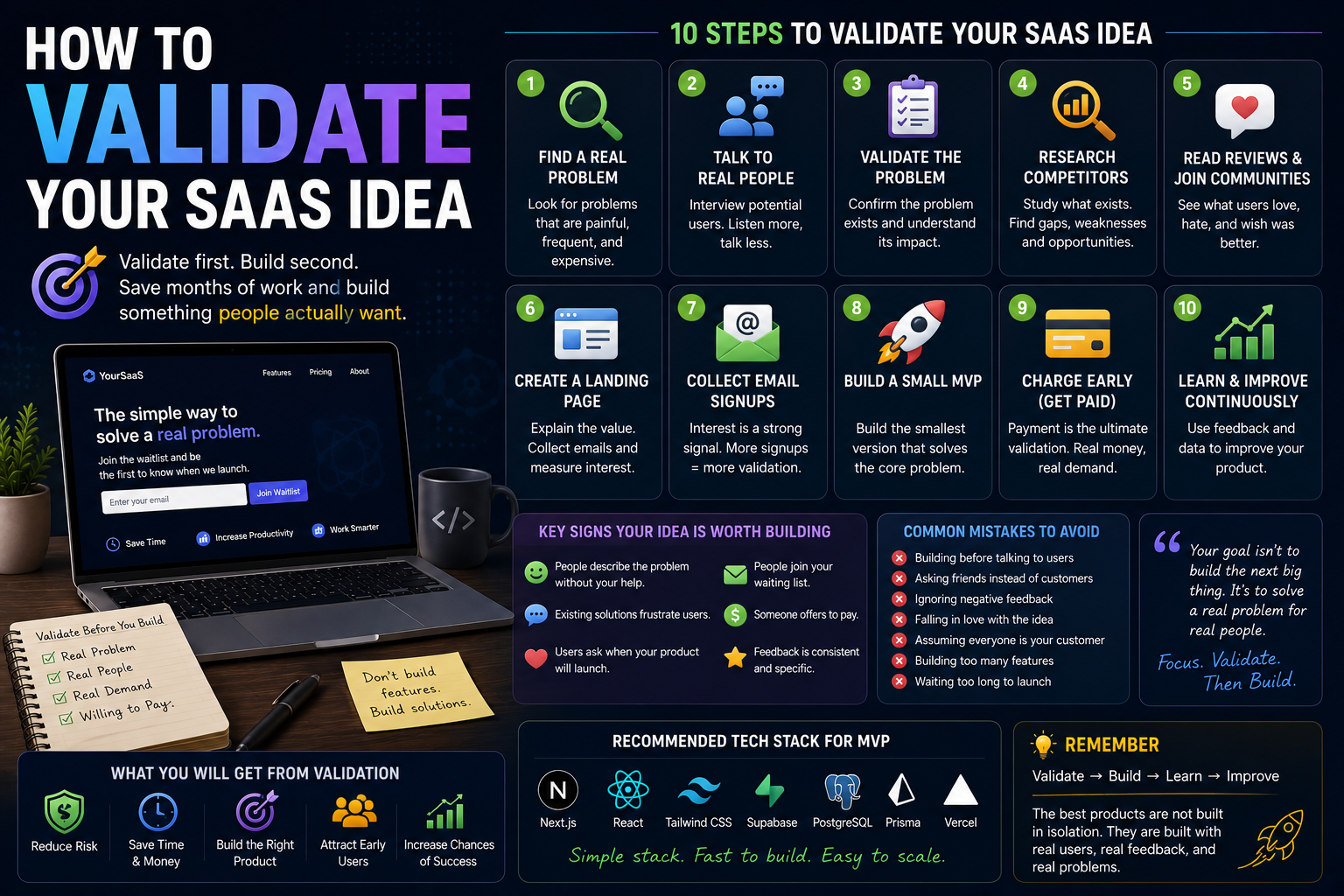
Building before talking to users.
Asking friends instead of customers.
Ignoring negative feedback.
Falling in love with the idea.
Assuming everyone is your customer.
Waiting too long to launch.
Building too many features.
Validation is about learning not proving yourself right.
A Simple Validation Process
You don't need a complicated strategy.
Follow these steps:
Identify a real problem.
Find people experiencing it.
Talk to potential customers.
Study competitors.
Create a landing page.
Collect email signups.
Build a small MVP.
Launch quickly.
Charge real customers.
Improve continuously.
This process dramatically reduces the risk of building something nobody wants.
Signs Your Idea Is Worth Building
Your idea is becoming stronger when:
People describe the problem without your help.
Existing solutions frustrate users.
Customers ask when your product will launch.
Users join your waiting list.
Someone offers to pay.
Feedback consistently points in the same direction.
These are encouraging signals that you're solving a meaningful problem.
Recommended Tech Stack
For validating a SaaS idea in 2026, you don't need a massive architecture.
A simple stack works perfectly:
Frontend
Next.js
React
Tailwind CSS
Backend
Next.js Server Actions
Database
PostgreSQL
Prisma ORM
Backend Services
Supabase
Authentication
Better Auth
Deployment
Vercel
The faster you build, the faster you learn.
Final Thoughts
The biggest mistake founders make isn't choosing the wrong technology.
It's building before validating.
A few conversations with potential customers can save months of unnecessary work.
Remember, your goal isn't to prove your idea is brilliant.
Your goal is to discover whether people genuinely need it.
The sooner you validate, the sooner you'll know whether to build, improve, or move on to a better opportunity.
Great SaaS products don't start with perfect code.
They start with a real problem and founders willing to listen.
Keep reading
Related Posts
Web Development
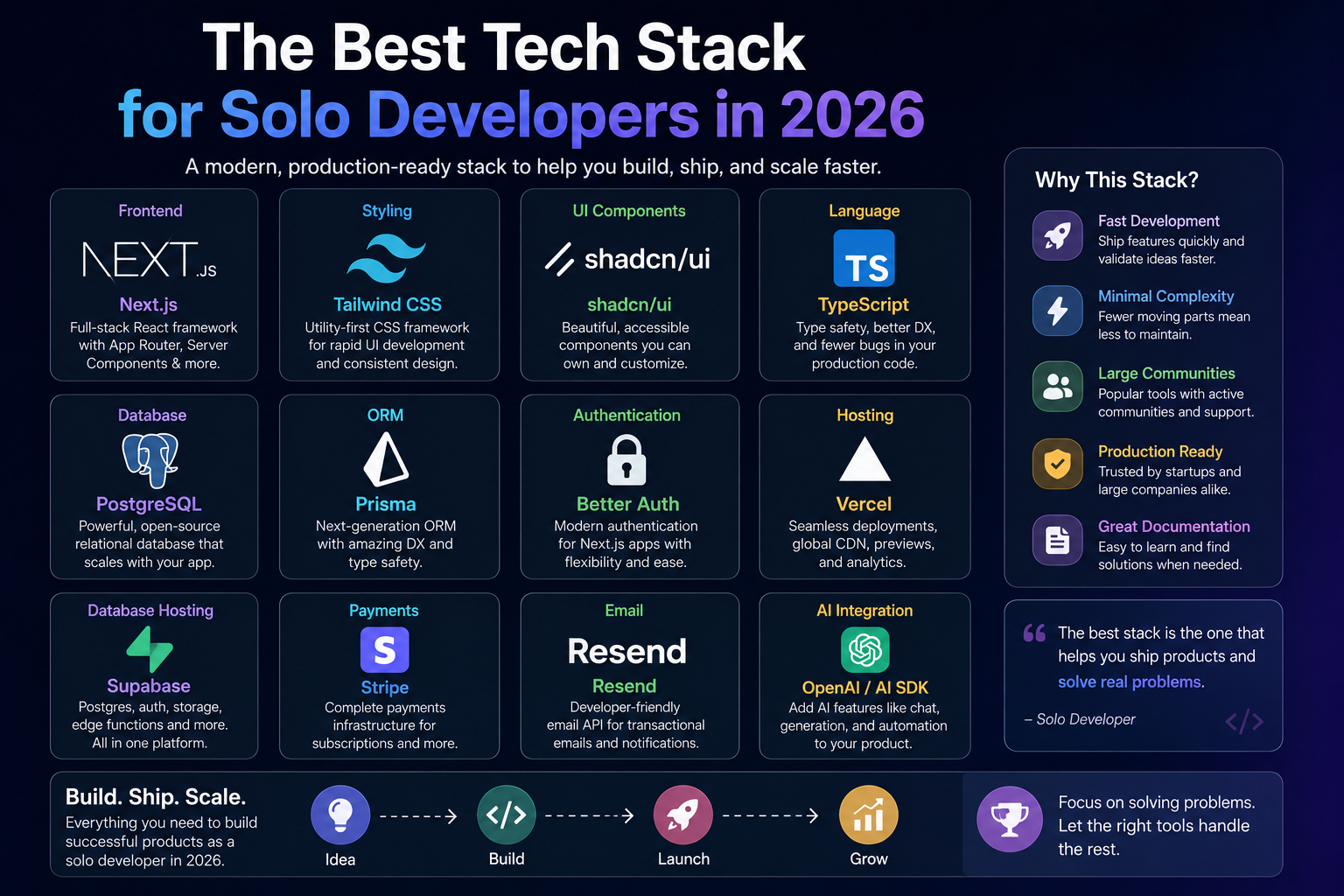
The Best Tech Stack for Solo Developers in 2026
Choosing the right tech stack can make or break a project—especially when you're building alone. As a solo developer, you need tools that help you move fast, stay productive, and scale without unnecessary complexity. Here's the tech stack I believe offers the best balance of speed, simplicity, and power in 2026.
4 min read · 114 views
AI & SaaS
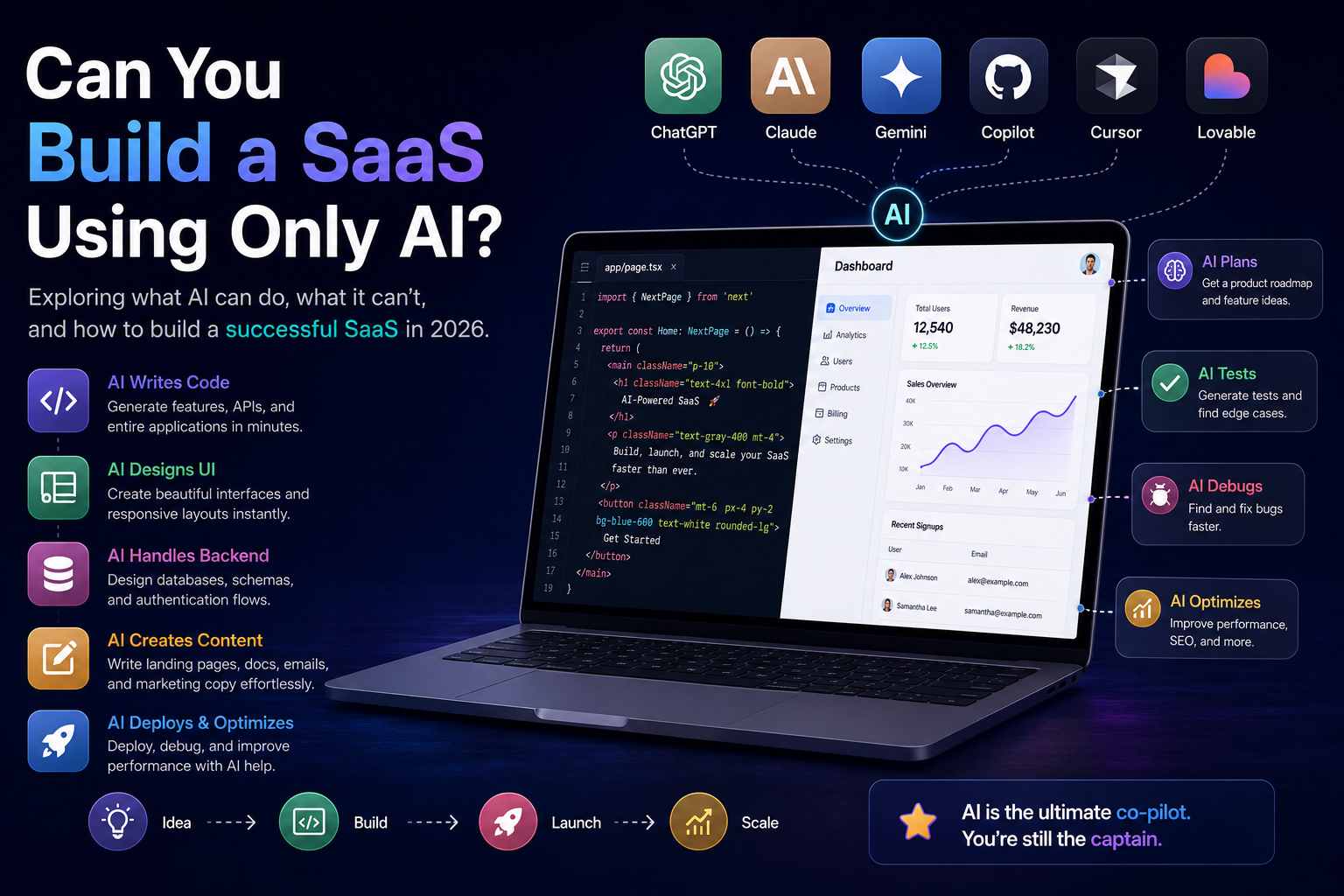
Can You Build a SaaS Using Only AI in 2026? The Honest Answer
AI can write code, design interfaces, generate content, and even help deploy applications. But can it build an entire SaaS business by itself? Let's separate hype from reality and explore what AI can—and cannot—do when building a modern SaaS product.
4 min read · 103 views
SaaS & Entrepreneurship
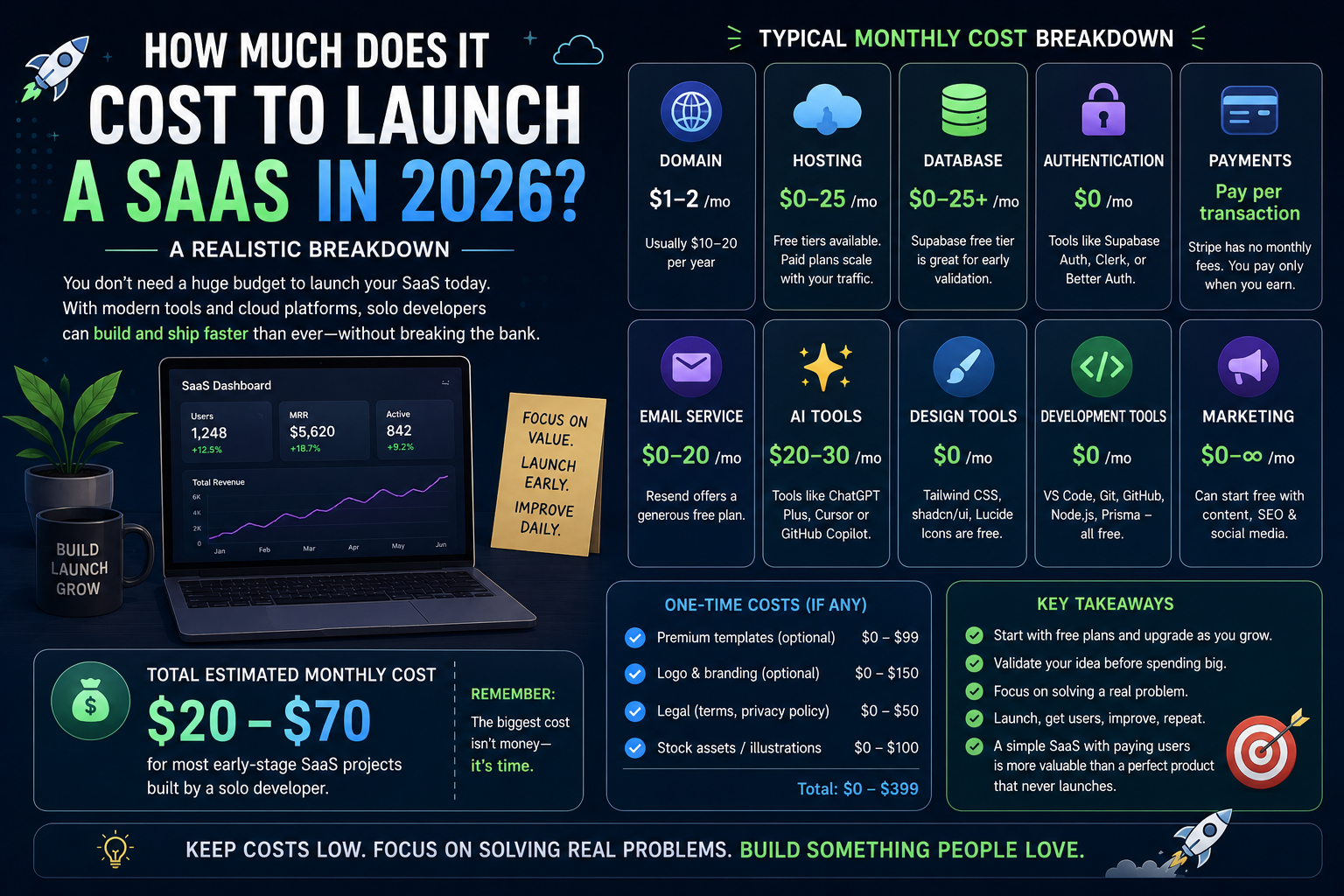
How Much Does It Cost to Launch a SaaS in 2026? A Realistic Breakdown
Launching a SaaS no longer requires hundreds of thousands of dollars. Thanks to modern frameworks, cloud platforms, and AI-powered tools, solo developers can build and launch professional software products on surprisingly small budgets. Here's a realistic look at what it actually costs to launch a SaaS in 2026.
4 min read · 101 views
Trending
Popular Posts
Productivity Tools That Save Developers Hours in 2026
681 views
The Most Valuable Skills to Learn in the AI Era (2026 and Beyond)
331 views
Vibe Coding vs Learning to Code: Which Path Will Take You Further?
277 views
Next.js 16 Features Every Developer Should Know in 2026
192 views
The Best Folder Structure for Next.js Projects in 2026
151 views
Comments
No approved comments yet.