JavaScript
Modern JavaScript Tricks That Save Time
By Yahya Saeed · 4 min read · 73 views
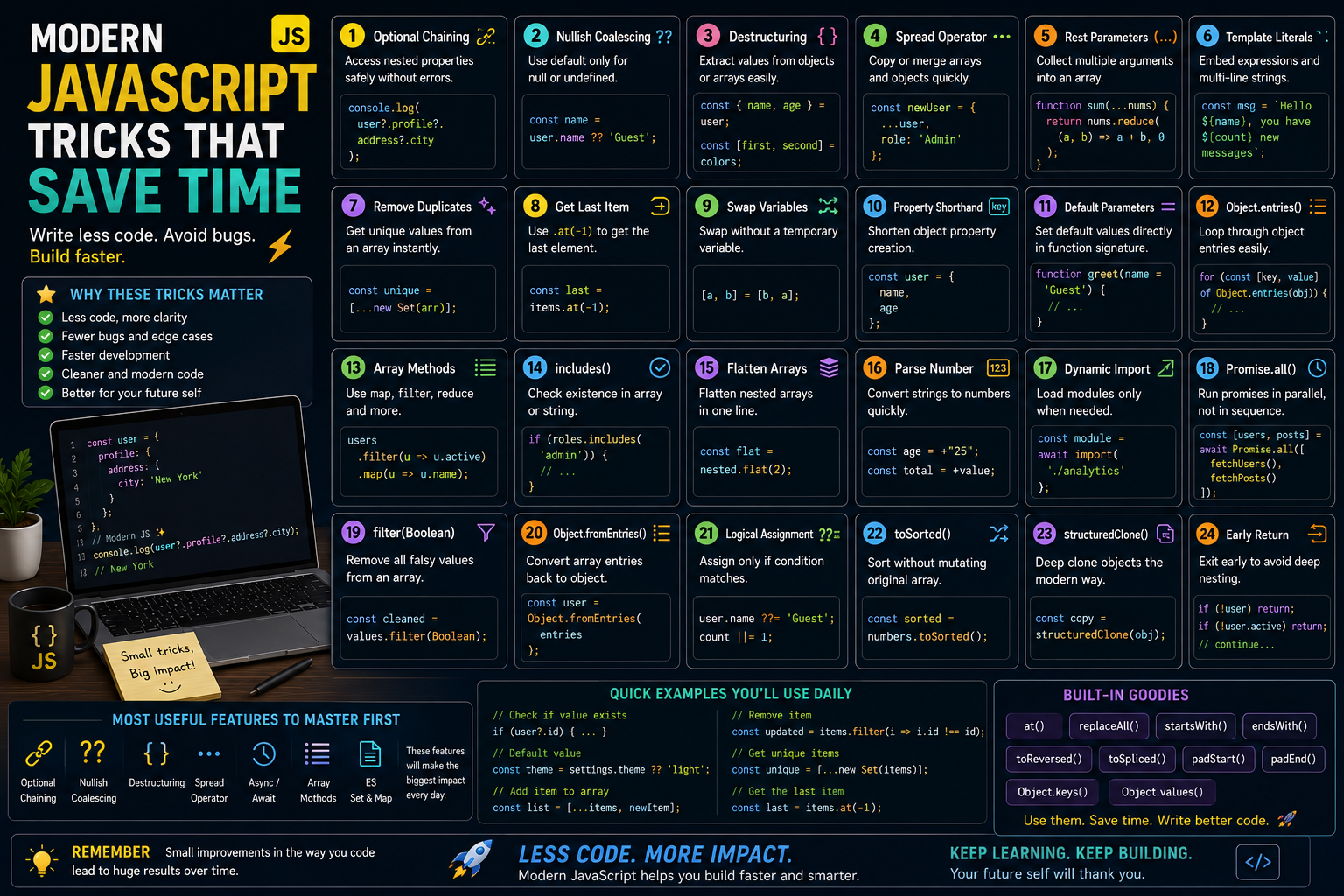
Modern JavaScript Tricks That Save Time
Every experienced JavaScript developer has a collection of small tricks that make coding faster and cleaner.
These aren't complicated algorithms or obscure language features.
They're practical techniques that save minutes every day.
And those minutes quickly become hours over the course of a year.
Modern JavaScript includes dozens of features designed to reduce boilerplate, prevent bugs, and improve readability.
If you're still writing JavaScript the same way you did a few years ago, you're probably doing more work than necessary.
Let's explore the JavaScript tricks every modern developer should know in 2026.
Use Optional Chaining Instead of Long Checks
Instead of writing:
if (user && user.profile && user.profile.address) {
  console.log(user.profile.address.city);
}
Simply write:
console.log(user?.profile?.address?.city);Cleaner.
Shorter.
Much easier to read.
Use Nullish Coalescing for Better Defaults
Many developers still use:
const username = user.name || "Guest";The problem is that values like:
0
false
""
will also trigger the default.
Instead use:
const username = user.name ?? "Guest";Only null and undefined use the fallback value.
Copy Objects Without Mutating Them
Instead of changing an object directly:
user.role = "Admin";Create a new object:
const updatedUser = {
  ...user,
  role: "Admin",
};
This approach works especially well in React state management.
Remove Duplicate Values Instantly
Instead of writing loops:
const unique = [...new Set(numbers)];Example:
const numbers = [1, 2, 2, 3, 4, 4];

const unique = [...new Set(numbers)];
Result:
[1, 2, 3, 4]Simple and incredibly useful.
Get the Last Item Easily
Old approach:
array[array.length - 1]Modern approach:
array.at(-1)It's cleaner and easier to understand.
Swap Variables Without a Temporary Variable
Instead of:
let temp = a;
a = b;
b = temp;
Use destructuring:
[a, b] = [b, a];One line.
No temporary variable.
Shorten Object Creation
Instead of:
const user = {
  name: name,
  age: age,
};
Write:
const user = {
  name,
  age,
};
JavaScript automatically understands the property names.
Destructure Function Parameters
Instead of:
function greet(user) {
  console.log(user.name);
}
Write:
function greet({ name }) {
  console.log(name);
}
Cleaner and more readable.
Use Default Parameters
Instead of:
if (!name) {
  name = "Guest";
}
Use:
function greet(name = "Guest") {
  return `Hello ${name}`;
}
Much simpler.
Convert Strings to Numbers Quickly
Instead of:
Number(value)You can also use:
+valueExample:
const age = +"25";Simple and fast.
Flatten Nested Arrays
Instead of loops:
const flat = nested.flat();Or:
const flat = nested.flat(2);Perfect when working with nested data.
Use Object.entries()
Instead of looping manually:
for (const [key, value] of Object.entries(user)) {
  console.log(key, value);
}
This is cleaner than older approaches.
Group Array Operations
Instead of multiple loops:
users
  .filter(user => user.active)
  .map(user => user.name)
  .sort();
Method chaining keeps transformations readable.
Use includes() Instead of indexOf()
Old:
if (roles.indexOf("admin") !== -1)Modern:
if (roles.includes("admin"))Much easier to understand.
Clone Objects Properly
Instead of:
JSON.parse(JSON.stringify(obj))Use:
structuredClone(obj);This handles many modern JavaScript data types correctly.
Dynamic Imports
Load code only when needed.
const analytics = await import("./analytics");This reduces initial bundle size and improves performance.
Use Promise.all()
Instead of waiting for requests one at a time:
const users = await fetchUsers();
const posts = await fetchPosts();
Run them together:
const [users, posts] = await Promise.all([
  fetchUsers(),
  fetchPosts(),
]);
Parallel execution is often much faster.
Prefer map() Over Manual Loops
Instead of:
const names = [];

for (const user of users) {
  names.push(user.name);
}
Write:
const names = users.map(user => user.name);Cleaner and more expressive.
Use filter(Boolean)
Remove falsy values instantly.
const values = [1, null, "", 5, undefined];

const cleaned = values.filter(Boolean);
Useful when cleaning arrays.
Use Object.fromEntries()
Convert arrays back into objects.
const user = Object.fromEntries(entries);Great when transforming data.
Use Logical Assignment Operators
Instead of:
if (user.name == null) {
  user.name = "Guest";
}
Write:
user.name ??= "Guest";Modern JavaScript provides:
??=
||=
&&=
These operators simplify assignments.
Use Template Literals Everywhere
Instead of:
"Hello " + nameUse:
`Hello ${name}`They're easier to read and support multi-line strings.
Use Rest Parameters
Instead of the old arguments object:
function sum(...numbers) {
  return numbers.reduce((a, b) => a + b, 0);
}
This works with arrays naturally.
Use Early Returns
Instead of deeply nested conditions:
if (!user) {
  return;
}

if (!user.active) {
  return;
}

console.log(user.name);
Early returns reduce nesting and improve readability.
Destructure Arrays
Instead of:
const first = colors[0];
const second = colors[1];
Write:
const [first, second] = colors;Simple and concise.
Use toSorted() Instead of sort()
Instead of mutating the original array:
const sorted = numbers.toSorted();Unlike sort(), this returns a new array.
Perfect for immutable code.
Use replaceAll()
Instead of regular expressions:
text.replaceAll("-", " ");Much easier for simple replacements.
Use Console Shortcuts Wisely
Useful debugging helpers include:
console.table(users);

console.time("API");

console.timeEnd("API");

console.group("User");

console.groupEnd();
These make debugging much more efficient.
Tricks Worth Learning First
If you're still improving your JavaScript skills, master these tricks first:
Optional Chaining
Nullish Coalescing
Destructuring
Spread Operator
Async/Await
Promise.all()
Set
Map
Template Literals
Array Methods
You'll use them almost every day.
Why These Tricks Matter
Each trick may save only a few seconds.
But over hundreds of coding sessions they make a significant difference.
They help you:
Write less code
Avoid common bugs
Improve readability
Reduce duplication
Build applications faster
Make maintenance easier
That's why experienced developers rely on them constantly.
Final Thoughts
Modern JavaScript is full of features designed to help developers write cleaner, faster, and more reliable code.
You don't need to memorize every trick overnight.
Start with the ones you'll use every day.
As they become second nature, your code will naturally become shorter, easier to understand, and more professional.
The best developers aren't the ones who write the most code.
They're the ones who solve problems with the simplest and clearest solutions.
Keep reading
Related Posts

Career & Technology
The Most Valuable Skills to Learn in the AI Era (2026 and Beyond)
Artificial Intelligence is changing how we work, learn, and build products. Some skills are becoming less valuable, while others are becoming more important than ever. If you want to stay relevant and thrive in 2026 and beyond, these are the skills you should focus on developing.
4 min read · 330 views

Programming
Vibe Coding vs Learning to Code: Which Path Will Take You Further?
AI can build apps faster than ever, leading to the rise of "vibe coding." But does that mean learning to code is no longer necessary? Let's explore the strengths, weaknesses, and future of both approaches to discover which path offers the greatest long-term value.
4 min read · 276 views

Next.js
Next.js 16 Features Every Developer Should Know in 2026
Next.js 16 continues to push modern web development forward with improved performance, better developer experience, enhanced routing, and powerful server-side capabilities. Whether you're building a blog, SaaS platform, portfolio, or enterprise application, these are the most important Next.js 16 features every developer should understand.
4 min read · 191 views
Trending
Popular Posts
Productivity Tools That Save Developers Hours in 2026
680 views
The Most Valuable Skills to Learn in the AI Era (2026 and Beyond)
330 views
Vibe Coding vs Learning to Code: Which Path Will Take You Further?
276 views
Next.js 16 Features Every Developer Should Know in 2026
191 views
The Best Folder Structure for Next.js Projects in 2026
151 views
Comments
No approved comments yet.